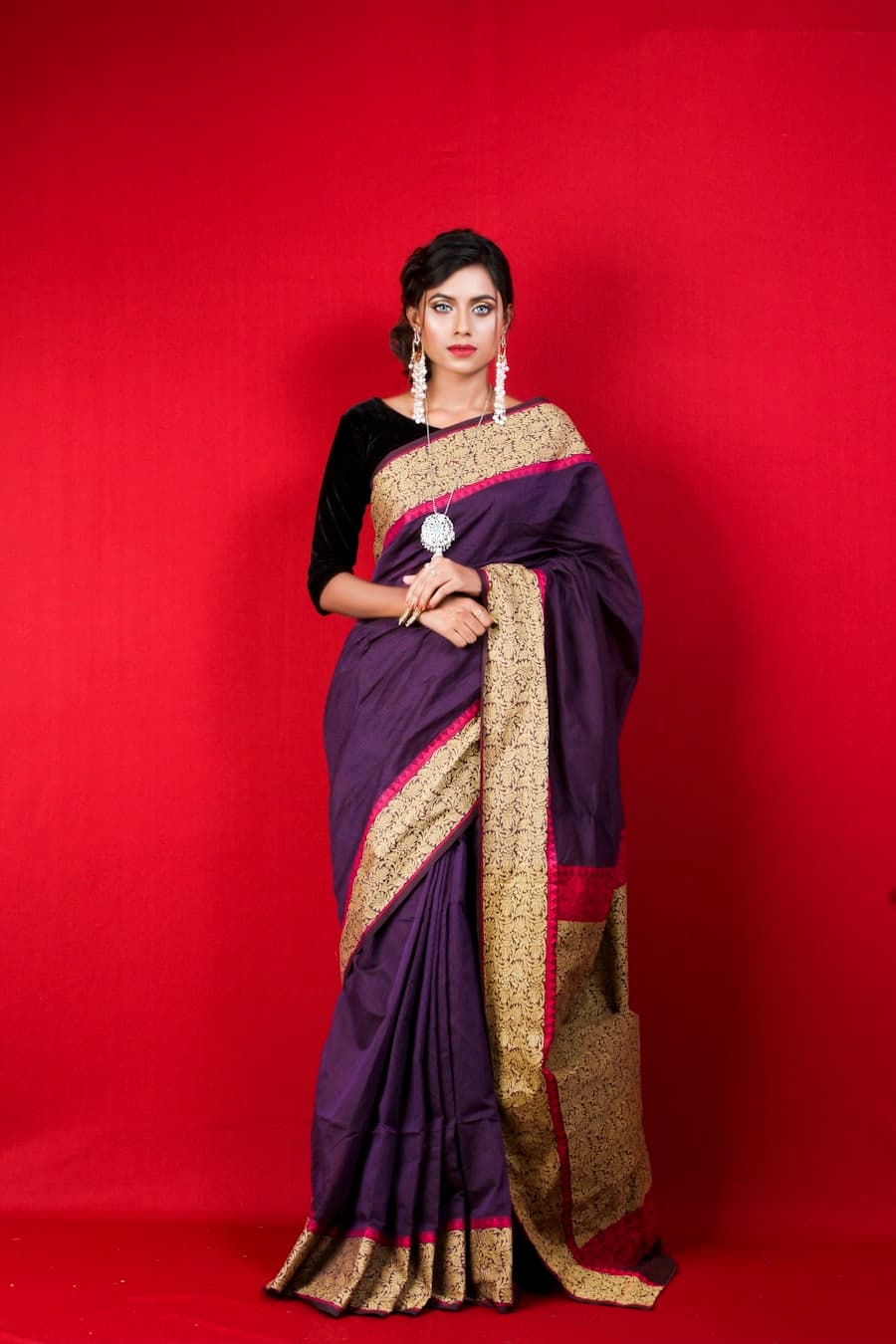
Akshaya Tritiya purchases are meant to compound, not depreciate. The pure-zari Banarasi katan is the saree this thinking was built for. Buy one today and your daughter wears it at her wedding.
Banarasi katan silk saree
- Region
- Varanasi, Uttar Pradesh
- Fabric
- Pure katan silk warp with tested-zari weft
- Technique
- Kadhua handloom — each motif woven discretely on the loom, not embroidered after
- Price band
- ₹35,000 — ₹2,50,000
The most-worn heritage saree in Indian wedding wardrobes for a reason. Pure katan silk has the dense, slightly stiff drape that holds pleats. Tested zari (real silver dipped in 24k gold) catches every kind of light differently from synthetic gold thread. The motifs to recognise: kalga and bel for understatement, jaal for full-coverage drama, brocade buttis for everyday-wedding wear.
The most-worn Banarasi colour at North Indian weddings. Reads as auspicious in nearly every Indian community.
South Indian-favoured. The Bangalore and Chennai mother-of-the-bride pick.
Real silver dipped in 24k gold. Catches warm light differently from synthetic gold thread.
The minimalist Banarasi. Reads modern with a chikankari blouse.
The reception-photo lead. Photographs deeper than it looks in person.
“A real kadhua takes us four to six months on the loom. Each motif is a separate weaving operation, not embroidery added later. That is what your eye learns to recognise.”
The classical southern read
Deep maroon or peacock-blue katan with a wide gold pallu. Pleated nivi drape. Polki jhumkas, a single gold mangalsutra, no other jewellery. Hair in a low bun with a single mogra gajra. This is the safest, most admired read of this saree at any wedding event south of Delhi.
- Banarasi katan in deep maroon
- Polki jhumkas
- Plain gold bangles, no kada
- Low bun with mogra
Worn down to the office
Ivory or sage katan with a thin gold border, minimal pallu motifs. White chikankari blouse instead of brocade. Tiny gold studs, a single thin gold chain, oxidised silver bangles. Hair down, pin-straight. Reads modern enough for a senior-team dinner and traditional enough for a Friday haldi. The piece that earns its hanger time.
- Ivory katan with thin border
- White chikankari blouse
- Stud earrings
- Open hair
When you are sitting front-row
Bottle green or fuchsia katan with a full-pallu jaal weave. Heavy polki choker plus jhumkas plus haath phool plus maang tikka. Sequin or zardozi blouse. Lehenga-style drape with the pallu pinned dramatically. Hair pulled back tight in a sleek bun. This is the look that gets framed.
- Fuchsia katan with full jaal
- Zardozi sleeveless blouse
- Polki choker set
- Maang tikka and haath phool
Every motif is a separate weaving operation on a handloom — not added embroidery. A single saree occupies one weaver and one loom for nearly half a year, which is why the price band starts where it does.
Akshaya Tritiya falls on the third lunar day of the bright half of Vaishakha. The word akshaya means undecaying. Three stories converge on the same day: Treta Yuga begins, Yudhishthira receives the Akshaya Patra (the bowl that never empties), and Sudama walks unannounced into Krishna's palace with a small gift that returns a hundredfold. The principle that applies to a saree is the same one that applies to gold. Buy something that compounds in meaning, not something that depreciates the moment it leaves the shop.
- Deepika PadukoneSangeet at her Bengaluru wedding to Ranveer Singh, in a Sabyasachi maroon Banarasi katan
- Alia BhattReception in 2022 in an ivory tissue Banarasi by Sabyasachi, paired with diamond polki
- Isha AmbaniAnant Ambani's pre-wedding events in heritage Banarasi pieces from the family vault
Some of these links are affiliate links. If you buy through them, Picsila may earn a small commission. It does not change the price you pay, and we only recommend pieces we would buy ourselves.
Tomorrow's edit lands at 7am.
One outfit decision a day, never a fluffy one. Free.
Subscribe to the daily edit