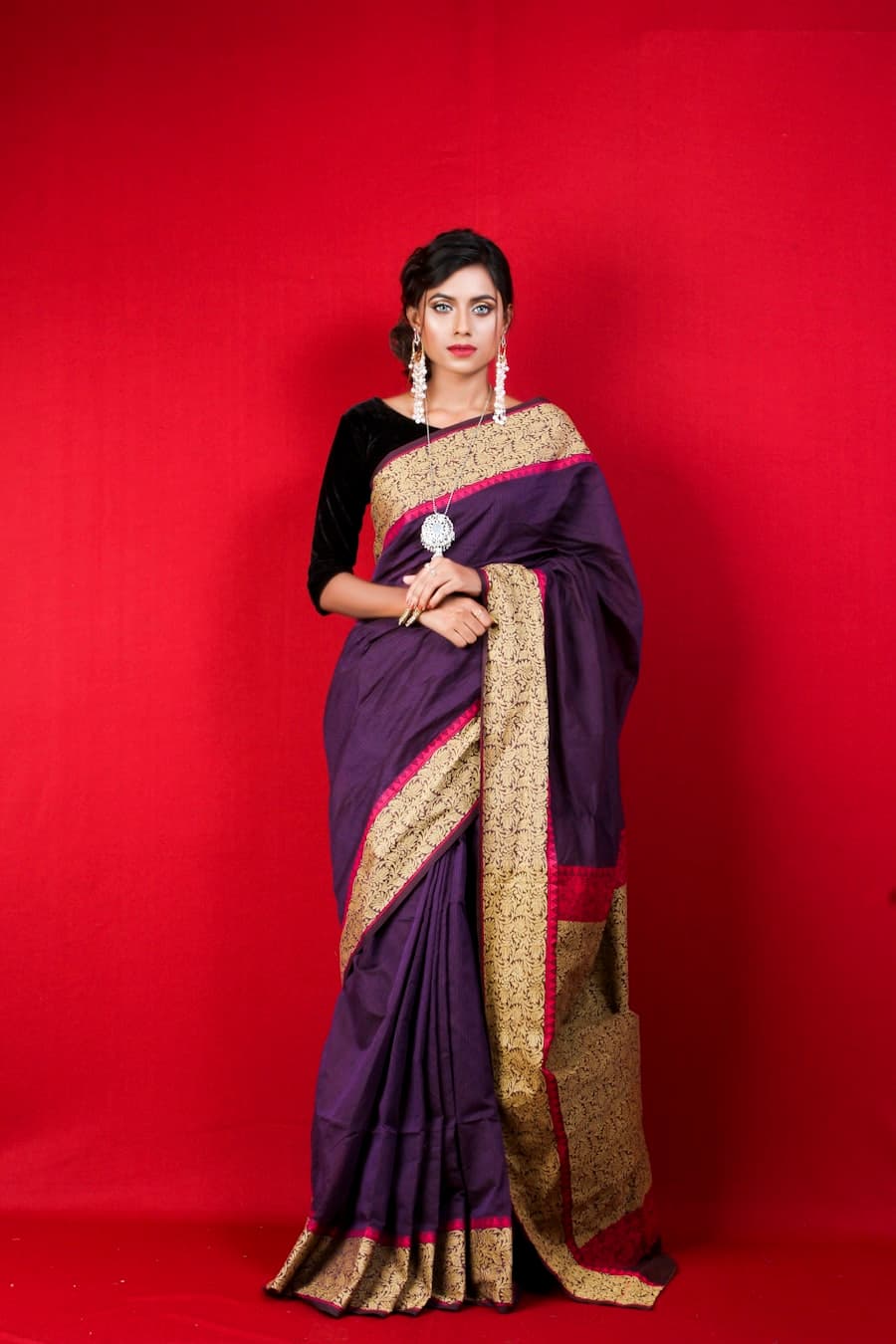
The Nauvari is not a costume. It is the most functional saree ever cut in India. The Bollywood revival is finally catching up with what Marathi women have known for three centuries.
Paithani Nauvari saree
- Region
- Yeola and Paithan, Maharashtra
- Fabric
- Pure mulberry silk with traditional Paithani gold zari, or cotton-silk khan blend for daywear
- Technique
- Nine-yard kachha-style drape, tied between the legs and pleated at the back, no petticoat needed
- Price band
- ₹15,000 — ₹2,00,000
The Paithani Nauvari is two textile traditions stitched into one garment. The base is Paithani: pure mulberry silk woven on a pit loom in Yeola or Paithan, with a wide pallu of gold zari motifs (peacocks, lotus, parrot, asavali vine) built one motif at a time using the interlocked-weft kadiyal technique. The length is Nauvari, nine yards instead of the standard five and a half, which allows the kachha drape with the centre pleat tucked at the back. Daily-wear versions use khan, a coarser cotton-silk blend traditionally woven in Solapur. The kashta drape is a regional variant from coastal Konkan. Avoid anything labelled Paithani that uses screen-printed motifs or synthetic zari that does not tarnish; both are giveaways of a Surat-mill copy.
The signature Paithani shade, named for the Peshwa court at Pune. The colour every Marathi bride considers first.
Popa green in Marathi. The traditional border colour on a pink Paithani. The green-on-pink pairing is the textile's visual signature.
The haldi-kunku colour. Worn at gauri-ganpati and at any event where a married Marathi woman wants to read as auspicious without overdoing it.
The Lavani-stage Nauvari. Reads dramatic under warm light, which is why folk dancers have worn it for two hundred years.
Worn for haldi and for early-summer festivals. The colour mothers pick when the daughter is too young for red.
“A real Paithani Nauvari is woven on a pit loom in Yeola over five to seven months. The pallu is built motif by motif, never printed. If the gold zari does not tarnish in your hand, it is not real.”
Mundavalya, nath, and a peshwa-pink Paithani
Peshwa pink Paithani Nauvari with a parrot-green border and full gold pallu. Mundavalya across the forehead, a Maharashtrian nath through the left nostril, kolhapuri saaj at the throat, green glass bangles stacked with gold patlya. Hair pulled into a low bun with a single mogra gajra and ambada flowers at the back. This is the bride's sister at a Marathi wedding, not the bride herself, and that distinction matters in how the jewellery is layered.
- Peshwa-pink Paithani Nauvari
- Mundavalya and Maharashtrian nath
- Kolhapuri saaj necklace
- Green glass bangles with gold patlya
Khan cotton, no fuss
Khan cotton-silk Nauvari in indigo or rust with a contrast border, draped kashta-style. White cotton blouse, oxidised silver jhumkas, a single thin gold chain. Open hair or a loose plait. This is the version a Pune architect or a Mumbai journalist actually wears to an office Gudi Padwa lunch. Reads cultural without reading bridal, which is the line most desi-day office dressing fails to find.
- Khan cotton-silk Nauvari in indigo
- White cotton blouse
- Oxidised silver jhumkas
- Loose plait
Stage-cut, contrast border, full pallu
Navy or magenta silk Nauvari with a wide contrast gold border and a heavily ornamented pallu pinned at the shoulder. Temple jewellery: vanki, oddiyanam, jhumkas, maang tikka. Hair in a tight bun with a chandra-surya headpiece. The kachha drape's freedom of movement is the entire reason classical and Lavani dancers have stayed loyal to this saree. A six-yard pleated nivi will not survive a tatkar sequence. Nine yards will.
- Silk Nauvari with contrast gold border
- Temple jewellery set
- Chandra-surya headpiece
- Tight bun with mogra
A standard saree runs five and a half yards. The Nauvari adds another three and a half so the fabric can be tucked between the legs and pleated at the back, dhoti-style. The drape was built for Maratha women fighting beside their men in the 17th century, not for stepping out of a Mercedes.
The Nauvari traces back to the 17th-century Maratha empire, where women rode and fought alongside Shivaji's army. The kachha drape was a battlefield adaptation; pleats tucked between the legs gave the same freedom of movement as a soldier's dhoti. The Peshwa court at Pune later refined the silk Paithani version into ceremonial dress, and Lavani folk dancers carried the drape into 19th-century performance. By the 1990s the Nauvari had collapsed into wedding-only and stage-only use, worn mostly by older women at gauri-ganpati. The 2015 release of Bajirao Mastani put it back into Bollywood's working vocabulary, and a generation of Marathi women in their twenties picked it up again, first for haldi-kunku and Gudi Padwa, now for office desi days and destination weddings.
- Deepika PadukoneAs Mastani in Bajirao Mastani (2015), in a sequence of Anju Modi Paithani Nauvaris that triggered the modern revival
- Kangana RanautAs Rani Lakshmibai in Manikarnika (2019), in battle-cut Nauvaris styled by Neeta Lulla
- Madhuri DixitPerforming Tabaad Tabaad at Marathi cultural events in a navy-and-gold Nauvari, and earlier in Kalank's Tabaah Ho Gaye sequence
Some of these links are affiliate links. If you buy through them, Picsila may earn a small commission. It does not change the price you pay, and we only recommend pieces we would buy ourselves.
- midPothys — Cotton-silk Nauvari in peshwa pink with parrot-green border₹18,000Shop ↗
- luxuryChandrakala Paithani — Handloom pure-silk Paithani Nauvari with peacock pallu, Yeola weave₹85,000Shop ↗
- heirloomAadyam Handwoven — Yeola Paithani Nauvari, pure mulberry silk with traditional asavali pallu₹2,10,000Shop ↗
Tomorrow's edit lands at 7am.
One outfit decision a day, never a fluffy one. Free.
Subscribe to the daily edit