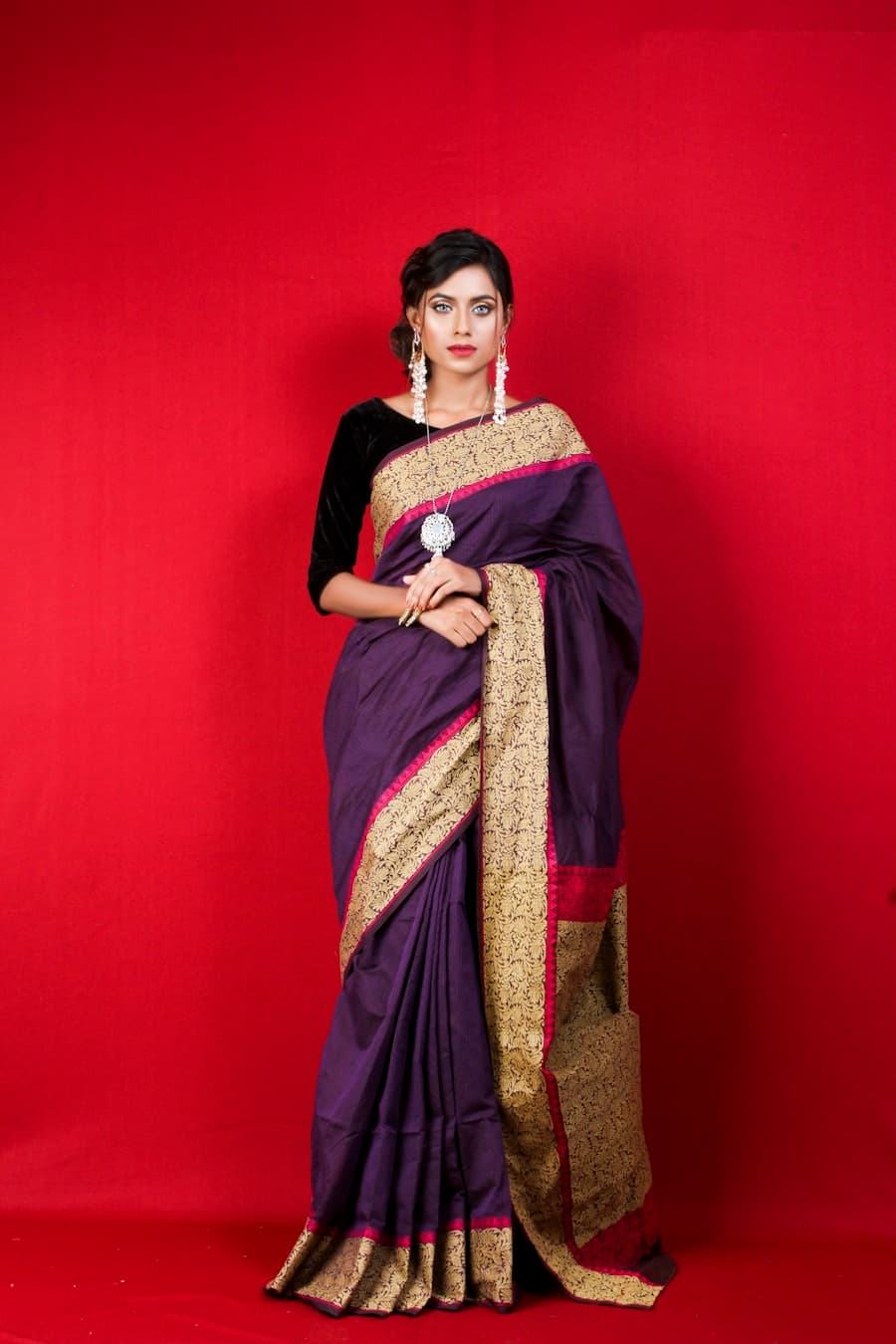
A Kanjeevaram is not one saree. The border width, the pallu motif and the colour palette tell a Chennai aunty exactly which sub-community the bride is from before the introductions start. Once you can read the code, you stop buying the wrong one for the wrong wedding.
Pure mulberry silk Kanjeevaram with korvai border
- Region
- Kanchipuram, Tamil Nadu
- Fabric
- Pure mulberry silk with thrice-twisted yarn, gold-coated silver zari (10g+ per saree)
- Technique
- Korvai weaving — body and border are woven separately on three shuttles and joined; the seam is invisible in a true Kanjeevaram
- Price band
- ₹40,000 — ₹4,00,000
The Kanjeevaram is built differently from any other Indian silk. The mulberry yarn is twisted three times before it is dyed, which is what gives the saree its weight and its near-indestructible drape. The border and pallu are woven on separate shuttles in a contrasting colour. That is the korvai. The third shuttle interlocks the two warps with a stitch called petni, fine enough that the join reads as a single weave from a metre away. The motifs to recognise: rudraksha (Iyengar households), yali (a mythical lion-elephant for Iyer trousseau), kuyil kann (the cuckoo's eye for Chettiar pieces), and the broad temple-gopuram border that runs across all sub-communities. GI tag protected since 2005, which is why the polyester impostors sold online as 'art silk Kanjeevaram' are not, by law, Kanjeevarams.
The deep maroon every Tamil bride wears at the muhurtham. Iyer brides in particular favour this with a mustard or parrot-green border.
Read as royal across South India. The Iyengar mami's reception colour, almost always paired with a wide gold pallu and rudraksha motif.
Fertility and growth. The bridesmaid colour for a Tamil sister of the bride and the standard return-mehendi-day choice in Chettiar households.
Auspiciousness and turmeric. Worn at the nichayathartham (engagement) by Iyer and Mudaliar brides; almost never the wedding-day saree itself.
Real silver dipped in 24k gold. A Kanjeevaram uses 10 grams or more per saree, which is why a heritage piece weighs close to two kilos.
“If the border colour matches the body colour, that is not a Kanjeevaram. That is a Kanjeevaram-style. A real one is woven on three shuttles: the body, the border and the petni that joins them. You can feel the join with your thumbnail and you cannot see it with your eyes. That is the test.”
Aramani red and the wide mustard korvai
Aramani red body with a contrasting mustard or parrot-green korvai border, three to five inches wide. Yali motif on the pallu. Nine-yard madisar drape if the family insists, six-yard nivi if the bride does. Temple jewellery: oddiyanam at the waist, vanki on the upper arm, jhimkis. Hair in a kondai bun, jasmine and kanakambaram strung in three rows. This is the most-photographed muhurtham look in Mylapore.
- Aramani Kanjeevaram with mustard korvai
- Oddiyanam waist belt
- Jhimki earrings and vanki
- Triple-strand mallipoo gajra
Parrot green, lighter zari, no competition
Parrot green Kanjeevaram with a thin red or magenta border, simple buttis on the body, a half-pallu rather than a full-zari one. Diamond studs and a single gold chain. Hair in a low ponytail with a single mogra string. This is how a Tamil sister of the bride dresses without competing with the muhurtham saree. The pacha also photographs cleaner against the bride's red than another red would.
- Parrot green Kanjeevaram with thin border
- Diamond studs
- Single thin gold chain
- Low ponytail with mogra
Peacock blue, worn down a register
Peacock blue Kanjeevaram with a thin gold border and minimal pallu motifs, paired with a plain raw-silk blouse rather than brocade. Pearl studs, a single gold chain, oxidised silver bangles instead of gold. Hair down, centre-parted. Worn to a senior-partner dinner at the Madras Club or a print-magazine anniversary at ITC Grand Chola. Reads heritage without reading bridal.
- Peacock blue Kanjeevaram with thin gold border
- Plain raw-silk blouse
- Pearl studs
- Open hair, centre part
A genuine Kanchipuram silk is woven with three shuttles running at once: one for the body, one for the contrasting border, and a third (the petni) that interlocks the two so the seam is invisible from the front and continuous from the back. A two-shuttle saree, however heavy the zari, is not a Kanjeevaram in the traditional sense.
Kanjeevaram weaving traces back to the Pallava dynasty in 7th-century Kanchipuram, the temple town the Pallava kings built around the Kailasanathar shrine. The origin myth credits Sage Markanda, the weaver of the gods, whose descendants are said to have settled in Kanchipuram and taught the craft to the Saliya and Devanga weaving communities who still hold the looms today. The saree received India's Geographical Indication protection in 2005, which legally restricts the name to silks woven inside the Kanchipuram region from pure mulberry yarn with real zari. The protection matters because the market is now flooded with polyester and viscose imitations sold under terms like 'art silk Kanjeevaram' or 'soft silk Kanchipuram'. Neither is a Kanjeevaram under the GI registry, and neither is woven on three shuttles. If a saree is being sold below ₹15,000 with the word Kanjeevaram on the label, it is almost certainly neither.
- Aishwarya RaiHer own 2007 wedding to Abhishek Bachchan in a gold Neeta Lulla Kanjeevaram, woven in Kanchipuram, with the traditional aramani border. The Tamil Bunt code, read correctly.
- Vidya BalanAlmost every film promotion since 2010 in a Kanjeevaram. The actress single-handedly responsible for the saree's return to Bollywood red carpets, regular collaborator with Sundari Silks Chennai.
- NayantharaHer 2022 wedding to Vignesh Shivan in Mahabalipuram in a heavy gold Jayalakshmi Silks Kanjeevaram with traditional Mudaliar broad border, paired with temple jewellery from Vummidi Bangaru
Some of these links are affiliate links. If you buy through them, Picsila may earn a small commission. It does not change the price you pay, and we only recommend pieces we would buy ourselves.
- midRmKV Silks — Pure mulberry Kanjeevaram with korvai border, aramani and mustard₹42,000Shop ↗
- luxuryNalli Silks — Heritage Kanchipuram with rudraksha pallu, peacock blue and gold₹1,20,000Shop ↗
- heirloomAadyam Handwoven — Aadyam Kanjeevaram with traditional yali pallu and broad temple border₹3,50,000Shop ↗
Tomorrow's edit lands at 7am.
One outfit decision a day, never a fluffy one. Free.
Subscribe to the daily edit